


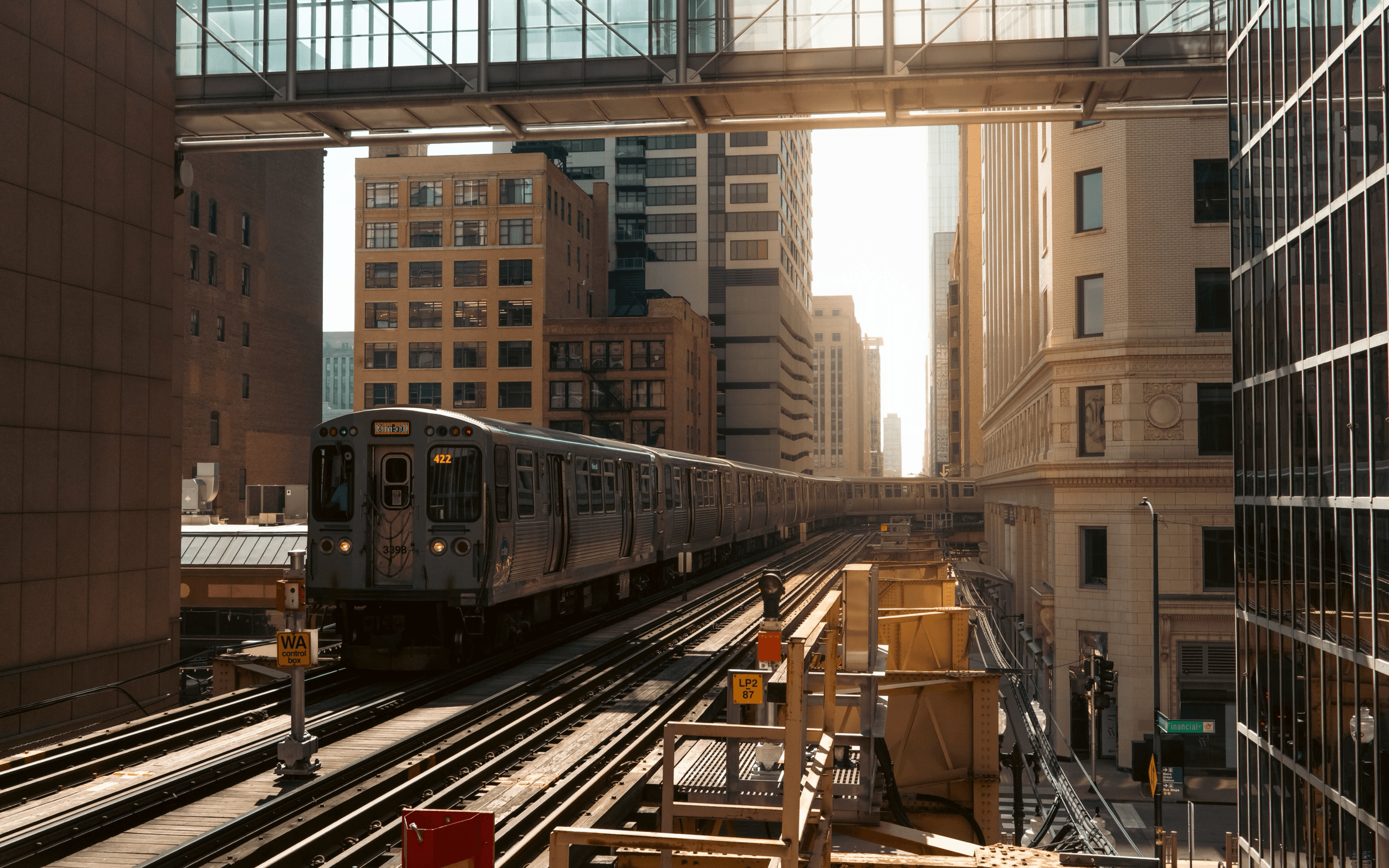
The L is Chicago’s train system, run by the CTA. It has eight lines, each named for a color, and 146 stations in the city and nearby suburbs. A ride costs $2.50 wherever you get on, except at O’Hare, where it costs $5. The Red and Blue Lines run 24 hours a day. The other six stop overnight.
We built Transit Stats so riders can log every CTA trip. Through October 2026 the Red Line was the one they logged most.
What is the Chicago L?
L is short for elevated, after the tracks built above the street. Chicago’s first rail line opened on June 6, 1892. The CTA treats L as the official name now and writes it with quote marks, as the ‘L’.
A lot of it still runs above the street. The CTA counts 35.8 miles of elevated structure, 35 miles at ground level, 20.6 miles on embankments and 11.4 miles of subway. It also counts 224.1 miles of track.
On an average weekday in 2025 people took 421,346 rides on the L. The trains make about 2,374 trips a day.
The lines have been named for colors since February 21, 1993. The Pink Line is the newest of the eight. It began service on June 25, 2006.
The eight CTA L lines and their routes
Six of the eight run downtown all day. The Purple Line gets there only in weekday rush periods, and the Yellow Line never does.
- The Red Line runs between Howard on the North Side and 95th/Dan Ryan on the South Side, through a subway downtown. It has 33 stations and runs at all times.
- The Blue Line runs between O’Hare airport and Forest Park, through its own downtown subway. Like the Red Line, it has 33 stations and runs at all times.
- The Brown Line runs between Kimball and downtown, where it circles the Loop. It has 27 stations.
- The Green Line starts at Harlem/Lake, on the edge of Oak Park and Forest Park, crosses downtown and splits on the South Side. One branch ends at Ashland/63rd and the other at Cottage Grove. It has 31 stations.
- The Orange Line runs between Midway airport and the Loop, through the Southwest Side. It has 16 stations.
- The Pink Line runs between 54th/Cermak in Cicero and the Loop. It has 22 stations.
- The Purple Line runs between Linden in Wilmette and Howard, through Evanston. That stretch has nine stations. In weekday rush periods its Express trains keep going from Howard to the Loop.
- The Yellow Line runs between Dempster-Skokie and Howard. It has three stations. The CTA says people still call it the Skokie Swift, its original name.
A station that several lines share is counted once for each line here, which is why the eight add up to more than 146. The counts include State/Lake, which is closed.
Howard is where the Red, Purple and Yellow Lines meet. Clark/Lake downtown has the most lines of any station, with six. The Blue Line is the longest of the eight at about 27.6 miles, and we measured them all for our ranking of the longest CTA bus routes and train lines.
How the Loop works
Downtown, five lines share one rectangle of elevated track above Lake, Wabash, Van Buren and Wells. That rectangle is the Loop. It opened on October 12, 1897, and downtown Chicago goes by the same name. One lap is about 2 miles.
Orange, Pink and Purple Line Express trains go around it clockwise. Brown Line trains go the other way. Each one makes every stop on the way round and then heads back out along the route it came in on. The Green Line doesn’t circle. It crosses along the Lake and Wabash sides and carries on.
The Loop has eight stations, and one of them is closed.
- Clark/Lake
- State/Lake
- Washington/Wabash
- Adams/Wabash
- Harold Washington Library-State/Van Buren
- LaSalle/Van Buren
- Quincy
- Washington/Wells
State/Lake is the closed one. It shut on January 5, 2026 for a rebuild the CTA says will run into 2029. Use Clark/Lake or Washington/Wabash instead.
If you’re on a Loop platform, read the sign on the front of the train before you get on. Orange Line trains to Midway, Pink Line trains to 54th/Cermak and Purple Line trains to Linden all go round the same way and stop at the same platform.
Does Chicago have a subway?
Yes, a short one. Of everything the L runs on, 11.4 miles is subway. The Red Line goes under State Street downtown, in a tunnel that opened on October 17, 1943. The Blue Line goes under Dearborn Street, in one that opened on February 25, 1951.
Those are the only two lines that go underground downtown, and the other five that reach downtown stay above the street on the Loop.
So if someone asks for the subway or the metro in Chicago, they mean the L. The CTA’s own welcome page calls them metro trains.
Which L line goes where
These are the stops for a few common trips.
- O’Hare airport is the last stop on the Blue Line, 40 to 45 minutes from downtown.
- Midway airport is the last stop on the Orange Line, 20 to 25 minutes from downtown.
- Wrigley Field is half a block west of the Red Line’s Addison stop.
- The White Sox ballpark is a block west of the Red Line’s Sox-35th stop. The Green Line’s 35th-Bronzeville-IIT stop is three blocks away.
- The United Center is a short walk from Damen on the Green Line, from Ashland on the Green and Pink Lines, and from Illinois Medical District on the Blue Line.
- Soldier Field and the Museum Campus are east of Roosevelt, a stop on the Red, Orange and Green Lines. The walk takes about 15 minutes, or the 146 bus goes from Roosevelt to the museums.
- The Art Institute is a block east of Adams/Wabash on the Loop.
- Chinatown has its own Red Line stop, Cermak-Chinatown.
- McCormick Place has its own Green Line stop, Cermak-McCormick Place.
- Evanston is on the Purple Line.
Our guide to getting to O’Hare and Midway on the CTA has the fares and where to find each airport station.
When the L runs
The Red and Blue Lines run 24 hours a day, every day. The other six shut down overnight. Their last trains leave between 11 p.m. and a little after 2 a.m., and on weekdays the first ones leave between 3 and 5 a.m. On Sundays and holidays they start later.
The Yellow Line finishes first, a little after 11 p.m. The Brown Line keeps going until a little after 2 a.m. most nights. The Purple Line only reaches downtown in the weekday morning and afternoon rush. The rest of the week you change to the Red Line at Howard.
We list the first and last train on every line in which CTA lines run 24 hours.
L train fares and passes
One ride costs $2.50. Tap a Ventra card, a contactless bank card or your phone at the turnstile. The one exception is O’Hare, where getting on costs $5. Riding out to O’Hare is the regular $2.50.
Tap the same card again within two hours and up to two more rides are free, on a train or a bus.
If you don’t have any of those, the vending machines in every station sell a single-trip ticket for $3, or $5 at O’Hare. It covers up to three rides within two hours. A new Ventra card costs $5, and you get the $5 back as fare if you register the card within 90 days.
Passes give you unlimited rides on CTA trains and buses, and on Pace buses in the suburbs, starting from the first tap.
| Pass | Price |
|---|---|
| 1-Day pass | $5 |
| 3-Day pass | $15 |
| 7-Day pass | $20 |
| 30-Day pass | $75 |
A pass also covers the $5 fare at O’Hare. Children under 7 ride free with a paying adult, and children 7 to 11 pay a reduced fare of $1.25.
How to ride the L
- Pay at the turnstile. Touch your card or phone to the reader on top and walk through.
- Follow the signs to your platform. They name the end of the line the train is heading for, so know yours before you go in. Red Line trains go to Howard or to 95th/Dan Ryan. Blue Line trains go to O’Hare or to Forest Park, and at some hours they end at UIC-Halsted.
- Check the train when it pulls in. The front and the side show the line’s color and where it’s going.
- Let people off first, then move all the way into the car. Maps are posted in every car.
The CTA says every station has an employee on duty, so you can ask. It counts 110 of its 146 stations as accessible. Elevators do go out of service, so check its elevator alerts on the day you ride.
You can bring a bike on any train except in weekday rush periods, 7 to 9 a.m. and 4 to 6 p.m. Two bikes are allowed in each car.
For arrival times, open the Arrivals tab in Transit Stats. It shows live times for CTA train stations and bus stops, and the app is free. The CTA’s own Train Tracker also works on the web and by text message. We compared the other apps in the best CTA apps. If you ride the bus as well, we wrote a guide to CTA buses too.
The L lines Transit Stats riders log most
Transit Stats riders had logged 48,306 rides through October 2026. The Red Line had the most of any line, 10,407. The Brown Line was second with 6,237 and the Blue Line third with 3,828. The full list is in Chicago’s most popular CTA stops and lines.
By the CTA’s count the busiest station is Clark/Lake, with 2.66 million entries from January through August 2026. We ranked the top ten in the busiest CTA stations and bus routes.
Transit Stats is free. It keeps a log of each ride you take and adds up your rides, distance and time, with a map of every stop you have used.
Sources
- CTA, Facts at a Glance (lines, stations, track miles, opening dates, 2025 ridership)
- CTA, How to ride the train (the name, paying, platforms and train signs)
- CTA, Schedules and Route Info (the eight line pages with each route, its stations and hours)
- CTA, Jackson station on the Red Line (a subway station on State Street)
- CTA, Jackson station on the Blue Line (a subway station on Dearborn Street)
- CTA, Fares (fares, transfers, tickets and passes)
- CTA, Reduced fare and free ride programs (children’s fares)
- CTA, Sports (stops for Wrigley Field, the White Sox, the United Center and Soldier Field)
- CTA, Museums (the Art Institute and the Museum Campus)
- CTA, Attractions (Chinatown and McCormick Place)
- CTA, Getting to and from the airports (ride times from the airports)
- CTA, Bike and ride (when bikes are allowed on trains)
- CTA, Bus and Train trackers explained (Train Tracker on the web, by text and in apps)
- CTA, Accessible transit (accessible stations)
- CTA, Hello and welcome (the CTA’s quick start page)


